Material guide
Limestone restoration and care
Softer and generally more porous than marble, with the same acid sensitivity. Most at home in a honed finish.
Limestone is a sedimentary calcium-carbonate stone, and chemically it behaves much like marble — it etches in acid and it scratches. The practical difference is porosity and softness: most limestone is more absorbent and more easily marked than most marble, so sealing and prompt spill management matter more.
Limestone rarely wants a high polish. Its character is in a soft, matte or honed surface that reads as stone rather than as glass, and most limestone specified by architects is intended to look that way. Pushing it to a mirror finish is usually possible but often fights the material.
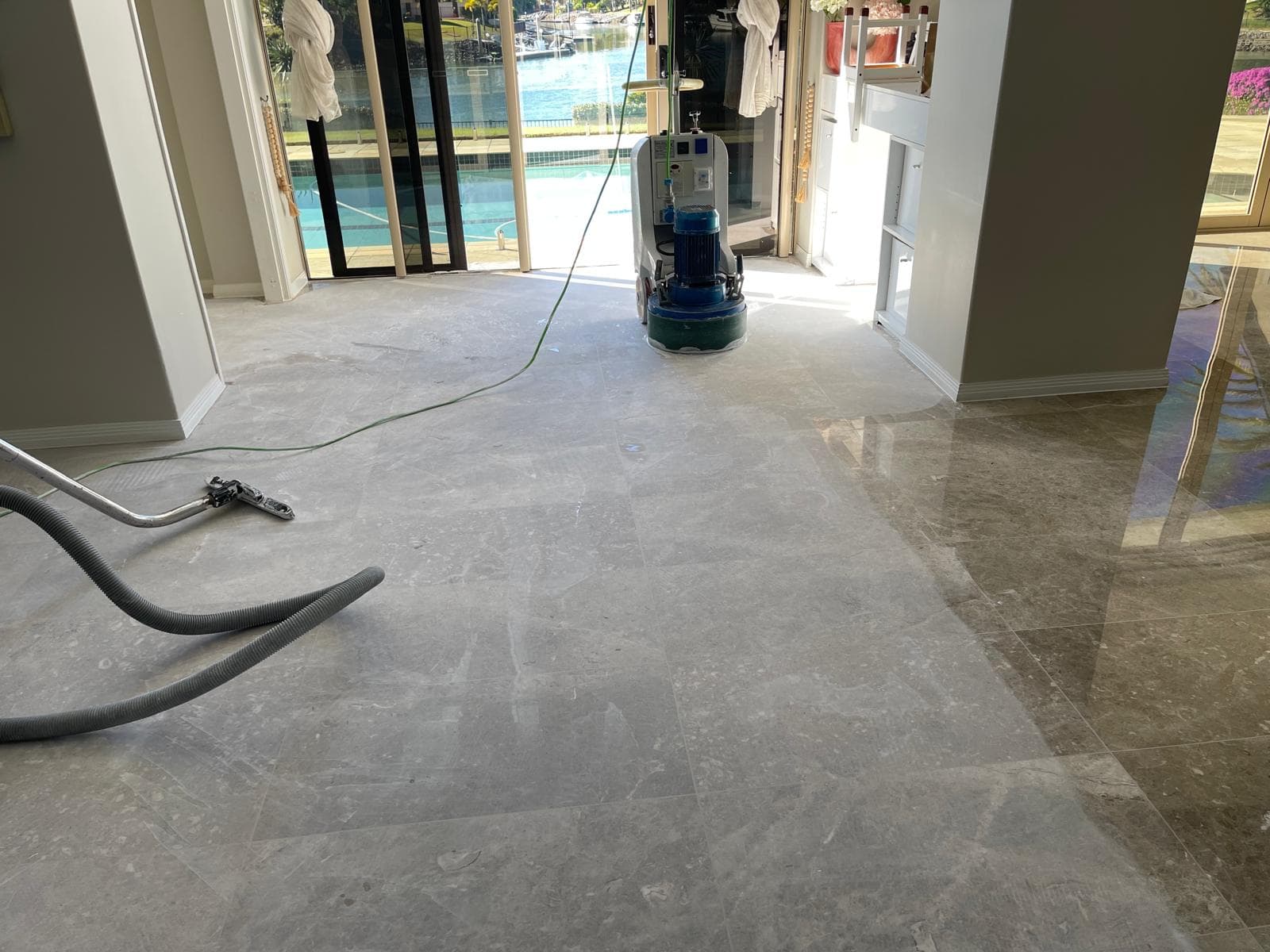
Because it is softer, limestone responds quickly to refinement — which cuts both ways. It is fast to bring back, and equally fast to damage with an aggressive approach.
Behaviour
What makes limestone different
These properties are the reason the method changes. They are not trivia.
- Calcite-based and acid-sensitive
- Typically more porous than marble, so staining is a greater risk
- Softer, so it wears and scratches faster in traffic
- Often contains visible fossils and shell inclusions
- Suits honed and matte finishes better than high polish
Common problems
What goes wrong, and whether it can be put right
Described as you would notice it, then what is physically happening, then what restoration can realistically achieve.
- 01
General loss of crispness, a chalky or tired appearance
- Cause
- Cumulative surface wear plus grit abrasion, particularly on floors.
- Outlook
- Correctable by refinishing to an even honed surface.
- 02
Dark or ringed staining around benchtop and vanity use points
- Cause
- Absorption through an unsealed or lapsed sealer. Limestone's porosity means liquids reach further in than on denser stone.
- Outlook
- Often substantially improved with poulticing, then sealed to prevent recurrence. Full removal depends on the substance and how long it sat.
- 03
Etch marks that look like water stains but will not wipe off
- Cause
- Acid contact, exactly as with marble.
- Outlook
- Correctable by refinishing.
Looking after it
Day-to-day care for limestone
A good share of the damage we repair was avoidable. This is the short version of how to avoid it.
Do
- Keep an effective impregnating sealer in place
- Blot spills immediately, especially oil, wine, and citrus
- Clean with pH-neutral products only
- Use matting at entries and rugs in high-traffic runs
Avoid
- All acidic cleaners
- Allowing spills to sit — porosity makes time the critical factor
- Abrasive pads and powders
- Assuming a sealer makes the stone stain-proof; it buys time, not immunity
Finishes
Finishes achievable on this stone
The finish is chosen to suit the stone and the room it is in, not applied as a default.
- honed
- matte
- natural
- polished
Other materials
We restore more than one kind of stone
Looking for a particular job rather than a particular stone? Browse stone restoration by what needs doing.
Not sure what your limestone needs?
Acidic cleaners, vinegar, lemon, wine, and many supermarket bathroom sprays will etch this stone. Etching is a chemical burn into the surface, not a stain sitting on top of it, so it cannot be wiped away or bleached out — it has to be ground and refinished.