Restoration
Pool Surrounds & Outdoor Stone
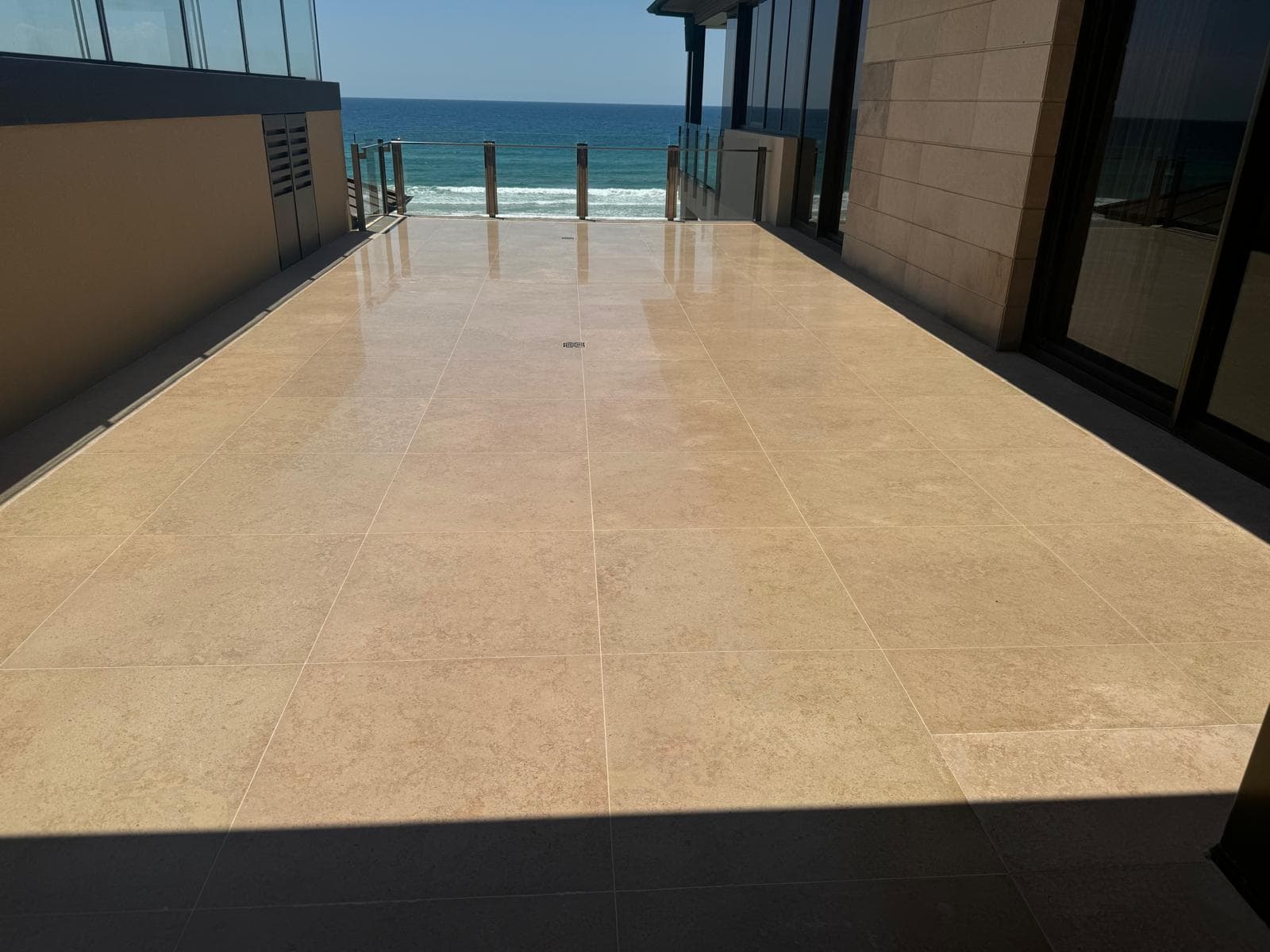
Coping, paving and alfresco stone exposed to weather, salt and chlorine. Slip resistance matters more than gloss.
The problem
What actually goes wrong
External stone deteriorates from exposure rather than traffic. Pool surrounds take chlorinated or salt water constantly, sunlight, and wet-dry cycling. Sandstone and limestone go patchy and biologically stained; bluestone can develop white mineral bloom; joints and coping edges break down.
Outdoors the priority is also different. A polished finish on a wet pool edge is a hazard, so restoring external stone is about texture, cleanliness and structural soundness rather than shine.
Assessment
What gets established before any work starts
These decide the method. Answering them wrong wastes an entire stage.
- Identifying the stone and its porosity, which governs both how it has failed and what can be done.
- Distinguishing biological growth and mineral deposit from staining within the stone. Outdoors, a lot of discolouration is living or sitting on the surface.
- Assessing slip resistance realistically in the wet, since that constrains the finish.
- Checking coping, joints and drainage, because water going where it should not is usually behind the worst of the damage.
Approach
How the work is decided
Described as a set of judgements rather than a fixed sequence, because that is how it genuinely works.
Cleaning and deposit removal come first, at a pressure and chemistry the stone will tolerate. Aggressive pressure washing erodes soft stone and opens the surface up to faster re-soiling, which makes the next year worse rather than better.
Where the surface is worn or inconsistent, honing brings it back to an even texture. Polishing is generally inappropriate on a trafficked wet external surface.
Joints, coping and any loose or drummy pieces are addressed as part of the work, since these are where water gets in.
Protection is chosen for exposure. An impregnating sealer suited to external use reduces absorption and slows biological staining; a film-forming product outdoors will fail under sunlight.
Stages that may be involved
Not every stage applies to every job. Which are used is decided at assessment.
Practicalities
Things worth knowing in advance
The details that affect how the job runs, and that are easier to plan for than to discover midway.
- Slip resistance outranks appearance
- Around a pool, a surface must stay safe underfoot when wet. That rules out finishes that would be perfectly reasonable indoors, and it is a constraint rather than a preference.
- Exposure continues after the work
- An external surface goes straight back into sun, water and weather. Realistic expectations and a maintenance plan matter more here than anywhere else on a property.
- Salt and chlorine behave differently
- A salt-water pool and a chlorinated one present different chemistry to the surrounding stone, and so does a coastal position. All three bear on the choice of treatment and sealer.
Limits
What restoration will not fix
Stated plainly, because finding out on the day suits nobody.
- Weathering that has eroded the surface profile of soft stone cannot be reversed, only evened out.
- Biological staining will return in shaded, damp positions; the work slows it rather than stopping it.
- Salt damage that has begun to break the stone apart is structural.
Materials
Stone this applies to
Each material behaves differently. The reference pages cover how, and how to look after them.
Questions
Common questions
It can, and it generally should not be. A polished stone edge around a pool is slippery when wet. Honing to an even, cleaner texture gives a better result that is still safe underfoot.
It removes surface growth, and on soft stone at high pressure it also erodes the surface and opens the pores, so it re-soils faster afterwards. Cleaning has to be matched to the stone rather than simply turned up.
Related
Often needed alongside this
Stain Removal
Drawing organic, oil, rust and mineral staining out of the stone rather than sealing it in.
Repairs & Surface Correction
Chips, cracks, holes and lippage. Structural and cosmetic correction of damaged stone rather than replacement.
Grout & Joint Restoration
Full-depth joint removal and rebuilding, including epoxy systems. A distinct intervention, not a stage of polishing.
Have the stone assessed properly
Send photographs and a short description and you will get a straight answer about what the surface needs — including if the answer is that it does not need us.