Restoration
Stone Benchtop Restoration & Repair
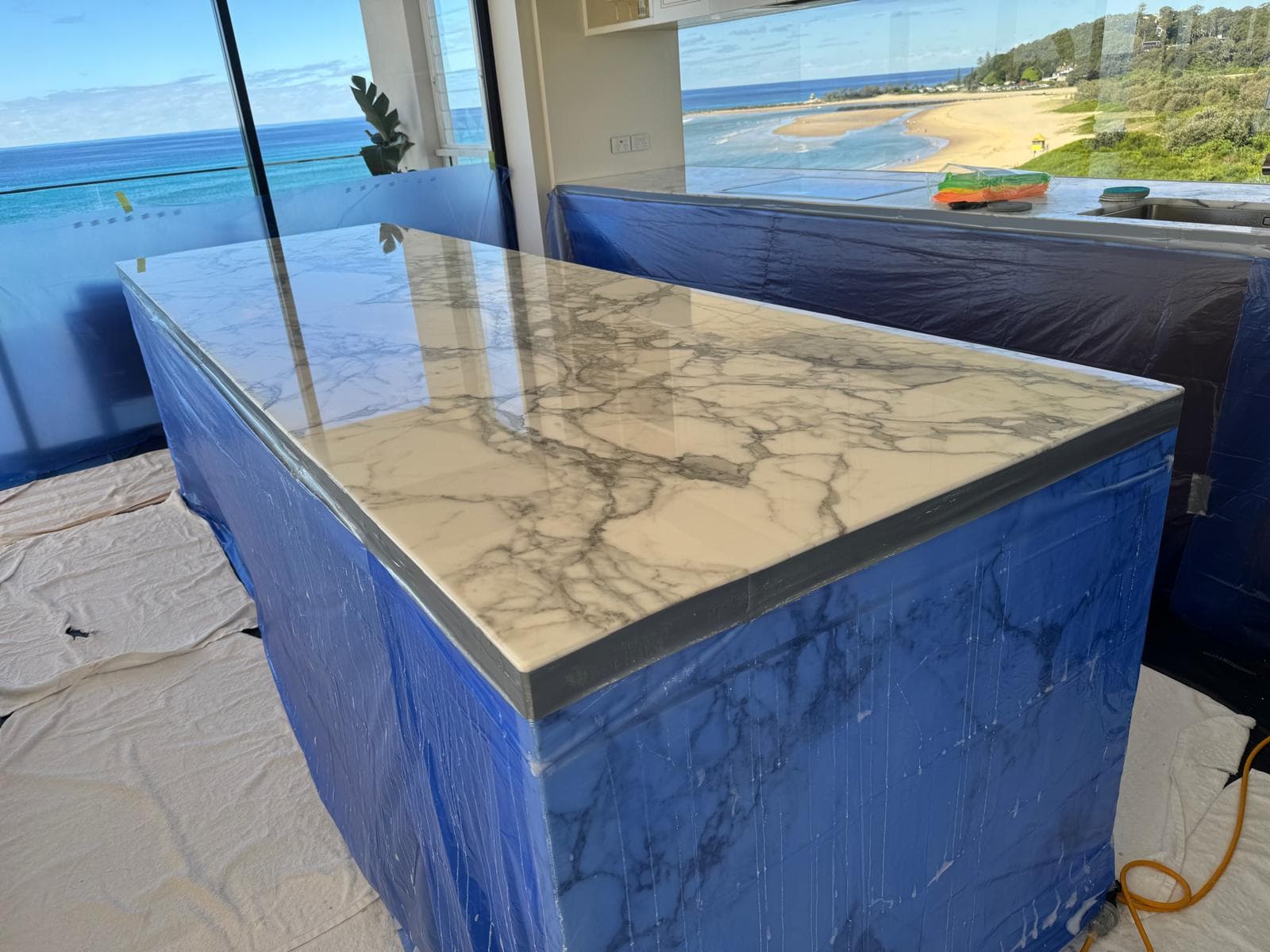
Kitchen islands, bar tops and vanities re-finished in place. Etching, dulling and chipped edges corrected on the stone itself.
The problem
What actually goes wrong
Benchtops fail differently from floors because of what happens on them. Acid is the main culprit: lemon juice, wine, vinegar and many common cleaning products chemically etch calcium-based stone. An etch is not a stain sitting on the surface — it is a small area where the polish has been dissolved away, which is why wiping and re-sealing do nothing for it.
Edges and sink cut-outs take the physical damage. Chips along a leading edge, around a tap or at a mitred corner are common, and on a dark polished stone they catch the light and read as bright white marks.
Assessment
What gets established before any work starts
These decide the method. Answering them wrong wastes an entire stage.
- Distinguishing etching from staining. They look similar to most people and need opposite treatments — etching is mechanical damage to the finish, staining is material absorbed into the stone.
- Testing whether the existing finish is the stone's own polish or a topical product applied over it.
- Examining edges, cut-outs and mitred joints, which is where repair rather than refinishing is usually needed.
- Checking the stone type. A honed limestone vanity and a polished granite island are different jobs with different achievable outcomes.
Approach
How the work is decided
Described as a set of judgements rather than a fixed sequence, because that is how it genuinely works.
Benchtop work is close, controlled and largely hand-guided. The surfaces are small, the edges are shaped, and there is fixed joinery and plumbing to work around, so this is not simply a floor method scaled down.
Etching is corrected by re-finishing the affected area of stone rather than filling or coating it. Depending on depth this may mean refinement through several abrasive grades, or on light etching a shorter polishing sequence.
Chips and cracks are repaired before refinishing, so the repair is refined along with the surrounding surface and sits flush rather than proud.
Sealing is genuinely useful here. Kitchen surfaces meet liquids constantly, and an impregnating sealer buys time to wipe up a spill before it is absorbed.
Stages that may be involved
Not every stage applies to every job. Which are used is decided at assessment.
Practicalities
Things worth knowing in advance
The details that affect how the job runs, and that are easier to plan for than to discover midway.
- Repairs are visible under scrutiny
- A well-executed chip repair is unobtrusive at normal viewing distance and colour-matched as closely as the material allows. It is not invisible under direct examination. Natural stone has movement and pattern that a filler cannot reproduce exactly.
- Working in a live kitchen
- Benchtop work happens in the middle of a functioning room. Cooktops, sinks and cabinetry are masked and protected, and the work is planned around how long the kitchen can be out of use.
- Sealing is not etch-proofing
- An impregnating sealer reduces absorption. It does not stop acid from etching a polished calcium-based stone. Anyone who tells you a sealer makes marble acid-proof is mistaken about the mechanism.
Limits
What restoration will not fix
Stated plainly, because finding out on the day suits nobody.
- Engineered and reconstituted stone is not restored the way natural stone is; its surface is largely resin and does not respond to the same abrasive sequence.
- A crack running the full width of a benchtop, particularly across a sink cut-out, may be a structural problem rather than a cosmetic one.
- Colour matching a repair depends on the stone. Heavily veined or strongly patterned material is harder to match than a uniform one.
Materials
Stone this applies to
Each material behaves differently. The reference pages cover how, and how to look after them.
Questions
Common questions
Those are almost certainly acid etches rather than stains, which is good news: the stone is intact, the polish over that spot has been dissolved. Re-finishing that area restores it. No amount of cleaning or sealing will, because there is nothing sitting on the surface to remove.
Chips are normally repairable in place. Replacement is a separate conversation, and usually only warranted where damage is structural or a large section is missing.
Natural stone restoration is what we do. Engineered surfaces behave differently because their surface is largely resin, and the honest answer is that the natural-stone method does not transfer to them.
Related
Often needed alongside this
Repairs & Surface Correction
Chips, cracks, holes and lippage. Structural and cosmetic correction of damaged stone rather than replacement.
Stain Removal
Drawing organic, oil, rust and mineral staining out of the stone rather than sealing it in.
Bathrooms & Showers
Wet-area stone, vanities and shower recesses. Where stone damage and failed joints usually arrive together.
Have the stone assessed properly
Send photographs and a short description and you will get a straight answer about what the surface needs — including if the answer is that it does not need us.