From a Laundry Water Leak to a Complete Stone Restoration
Hope Island, Gold Coast
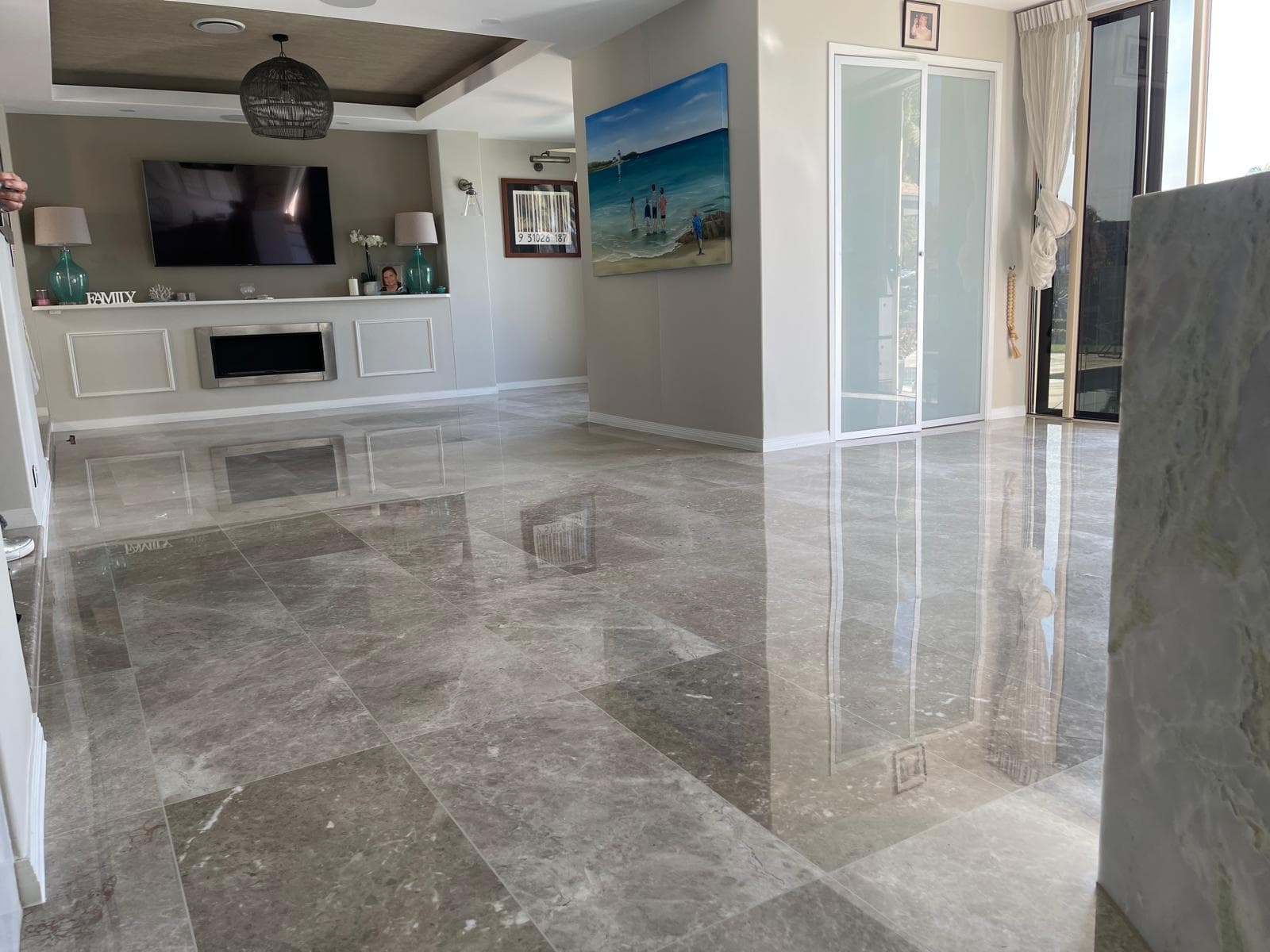
Penthouse floor restoration finished to a high-gloss, mirror-like reflection that carries the coastal light through an open-plan living area.
Natural stone restoration, machinery & professional diamond tools — Gold Coast, Brisbane & Sydney
Surfaces
Correction & Repair
Natural stone we restore
Compounds & treatments
Servicing the Gold Coast
The Gold Coast is our home market and where most of our work happens. Stone Polishing Solutions restores marble and natural stone for residential, luxury and commercial projects — bringing back the stone itself rather than applying a temporary surface shine.
Stone Polishing Solutions is a specialist natural stone restoration practice. Marble restoration, stone floor restoration and natural stone restoration across the Gold Coast are everyday work for us — worked back mechanically rather than hidden under a coating that will not last.
A topical gloss looks convincing for a while, then wears through in the traffic lanes and has to be redone. Mechanical restoration is different: the finish is produced in the stone itself, through progressively finer diamond stages, so it can be maintained in place rather than stripped and reapplied on a cycle.
The correct method depends on the material, the existing finish, the condition and damage, and the result you want. That is why every project starts with assessment rather than a fixed sequence of steps. You can read how we approach restoration and how each stage is decided.
Our approach
“We restore the stone itself — not just the shine on its surface.”
What we restore
Start from the problem you actually have. Each links to how that work is approached — the same methods apply whether the job is a single benchtop or a whole-home floor.
Stone floors levelled, refined and finished on site. The finish is the stone itself, not a coating laid over it.
Learn moreKitchen islands, bar tops and vanities re-finished in place. Etching, dulling and chipped edges corrected on the stone itself.
Learn moreWet-area stone, vanities and shower recesses. Where stone damage and failed joints usually arrive together.
Learn moreCoping, paving and alfresco stone exposed to weather, salt and chlorine. Slip resistance matters more than gloss.
Learn moreChips, cracks, holes and lippage. Structural and cosmetic correction of damaged stone rather than replacement.
Learn moreDrawing organic, oil, rust and mineral staining out of the stone rather than sealing it in.
Learn moreFull-depth joint removal and rebuilding, including epoxy systems. A distinct intervention, not a stage of polishing.
Learn moreWhole-home and multi-level stone across floors, bathrooms, kitchens and external areas, sequenced as one programme.
Learn moreLobbies, hotels, retail and body-corporate stone. Restored in stages around trading hours and occupied buildings.
Learn moreLocal expertise
This is a coastal, subtropical environment, and that changes what goes wrong with stone. The local building stock and climate decide what fails and how it should be treated.
Stone on balconies, pool surrounds and terraces here takes salt-laden air and strong UV year-round. Salt crystallising in the pores can lift a surface from below, and the damage is often mistaken for staining. It usually needs the stone opened up and re-finished, not just cleaned harder.
Pool & outdoor stoneApartment work is a large share of what we do here, and it comes with real constraints: booked lifts, restricted work hours, dust and noise limits, and body corporate approval. These are scheduling problems more than technical ones, but they shape how a job is planned.
Commercial restorationA lot of Gold Coast terrazzo from the 1970s and 1980s survives under carpet, vinyl or tile. It is frequently in better condition than the owner expects, and restoring it is usually both cheaper and better-looking than covering it again.
Stone floor restorationShowers and bathrooms in a humid climate stay wet for longer between uses. That accelerates joint failure and mineral deposit build-up, so wet-area work here tends to need grout restoration as well as stone work.
Grout & epoxy restorationFeatured Gold Coast project
Real documented work, not a stock image — the level and complexity of restoration we take on across the Gold Coast.

Hope Island, Gold Coast
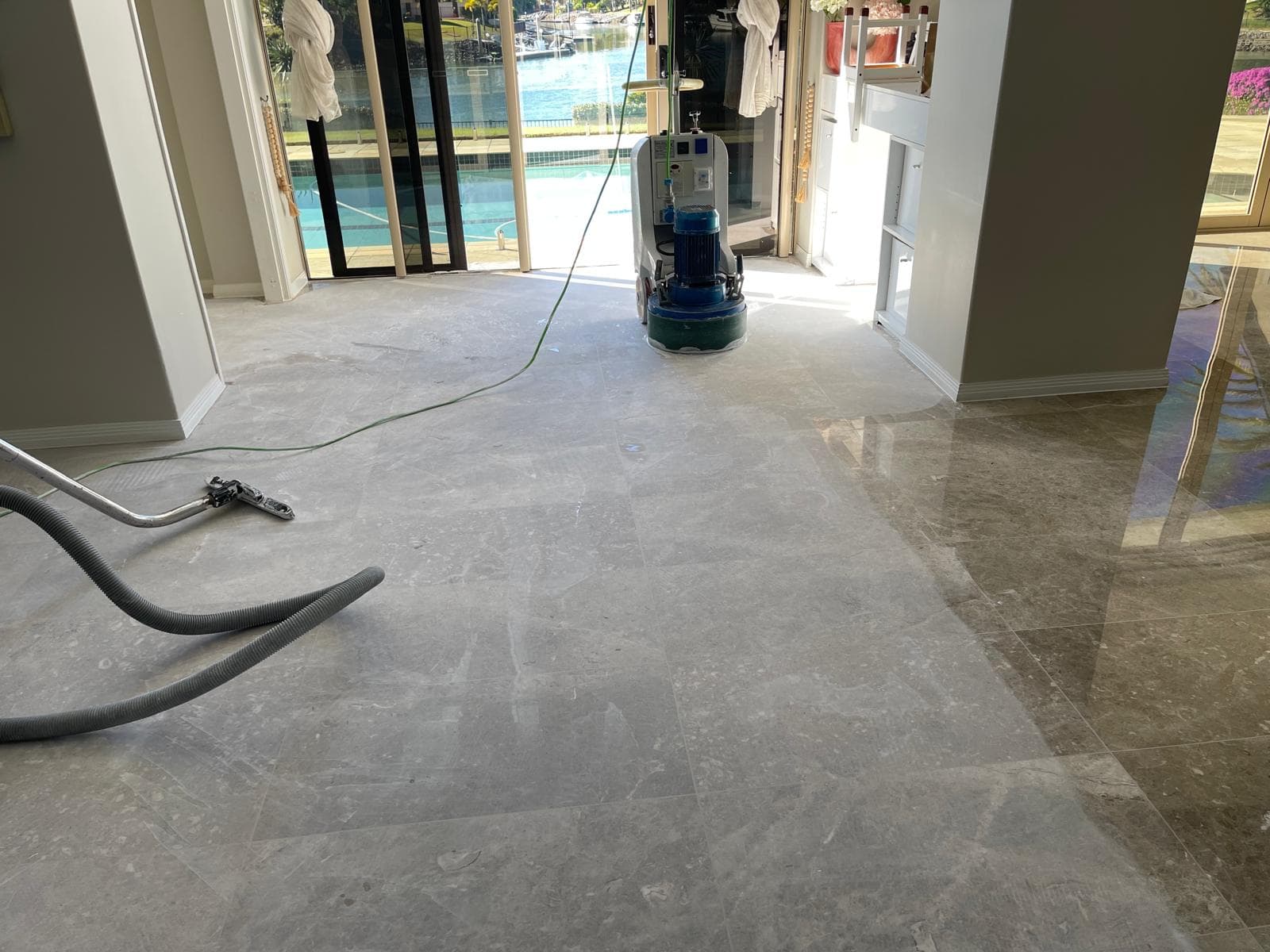
What began as a laundry water leak led to an initial restoration area and, ultimately, a complete restoration of roughly 150–160 m² of natural stone throughout the home.
The floor was finished to a high-gloss, mirror-like reflection produced mechanically in the stone itself — no topical coating — carrying the coastal light through the open-plan living area.
Large residential & luxury
Substantial residential restoration is core Gold Coast work — whole-home natural stone floors, large floor areas, high-end residences, complex multi-area restoration and architectural stone.
On projects of this scale we work collaboratively with homeowners, builders, architects and designers where relevant, and plan the work around site access, staging and the other trades involved. The approach is set by the stone and the condition of each area rather than a single specification applied across the whole property.
Large residential restorationCommercial
For suitable Gold Coast commercial projects, we restore large and hard-wearing natural stone to one consistent finish across the whole area rather than patching the worn sections.
Commercial and body corporate work is planned around a trading environment — access, work hours, dust and noise control, and coordination with building management. The finish is mechanical and maintainable, which matters most on stone that sees constant traffic in foyers and common areas.
Commercial restorationNatural stone
We restore natural stone only. Each material behaves differently under diamond abrasives and does not take the same process or finish, which is why identifying it correctly is the first step on any Gold Coast project.
Soft, calcium-based and prone to etching. The material we restore most.
Stone guidePorous and easily marked. Responds well to honing and impregnating sealers.
Stone guideNaturally voided. Often needs filling before grinding and honing.
Stone guideAggregate-set surfaces requiring heavy metal-bond grinding to expose stone.
Stone guideHard and dense. Needs higher-grade diamond tooling to re-polish.
Stone guideOpen-grained and absorbent. Common on outdoor and pool surrounds.
Stone guideDense basalt used outdoors. Restored by honing rather than polishing.
Stone guideOnyx, slate, quartzite and specialty stone worked case by case.
Stone guideMethod
There is no single restoration process. The correct sequence depends on the stone, its condition, the existing finish and the result you want. Grinding, honing, polishing, repairs and sealing are technical stages within that method — not standalone services, and not every project needs every one.
Cutting stone back with metal-bond diamonds to make it flat. The most aggressive stage, and often unnecessary.
Progressive refinement of the surface through finer abrasives. Produces a smooth, low-sheen finish, and is also the path to a polish.
Bringing the stone itself to a reflective finish mechanically. No coating, no wax, nothing applied that can peel.
Chips, cracks, holes and failed joints made good, colour-matched as closely as the material allows.
Stripping topical sealers, waxes and polymer glosses back off, so the stone underneath can be assessed and finished.
Drawing absorbed substances back out of the stone with poultices. A different problem from etching, and often confused with it.
Failed joints raked out and rebuilt properly, rather than smeared over with fresh grout on top of old.
An impregnating sealer to slow absorption. Buys time against staining — it does not make stone stain-proof.
If you are searching for “marble polishing Gold Coast”, this is where polishing fits: mechanical polishing may be one stage of a complete restoration where the stone and its condition suit it. It refines a sound, flat surface — it is not a fix for damage on its own, and not every stone should be polished.
Proof of work
Photographed jobs from the Gold Coast, each shown with its own true location. Real project photography is our evidence.

Hope Island, Gold Coast
Penthouse floor restoration finished to a high-gloss, mirror-like reflection that carries the coastal light through an open-plan living area.

Mermaid Beach, Gold Coast
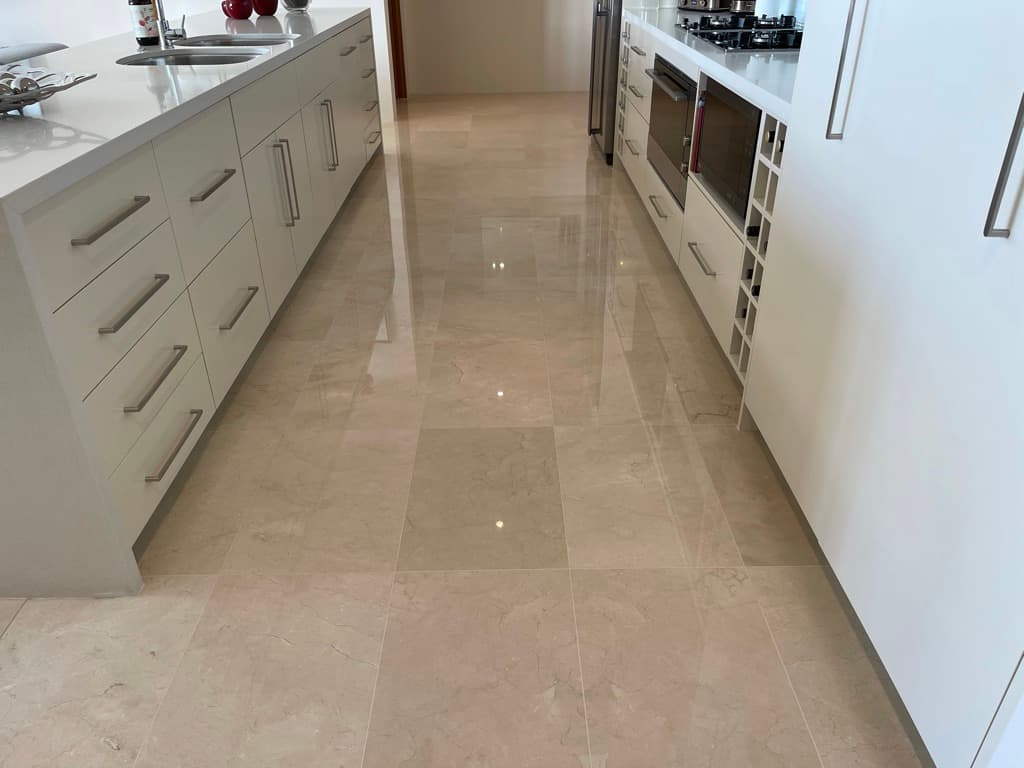
Marble kitchen floor honed back to an even, organic finish and protected with a high-performance breathable sealer.

Gold Coast
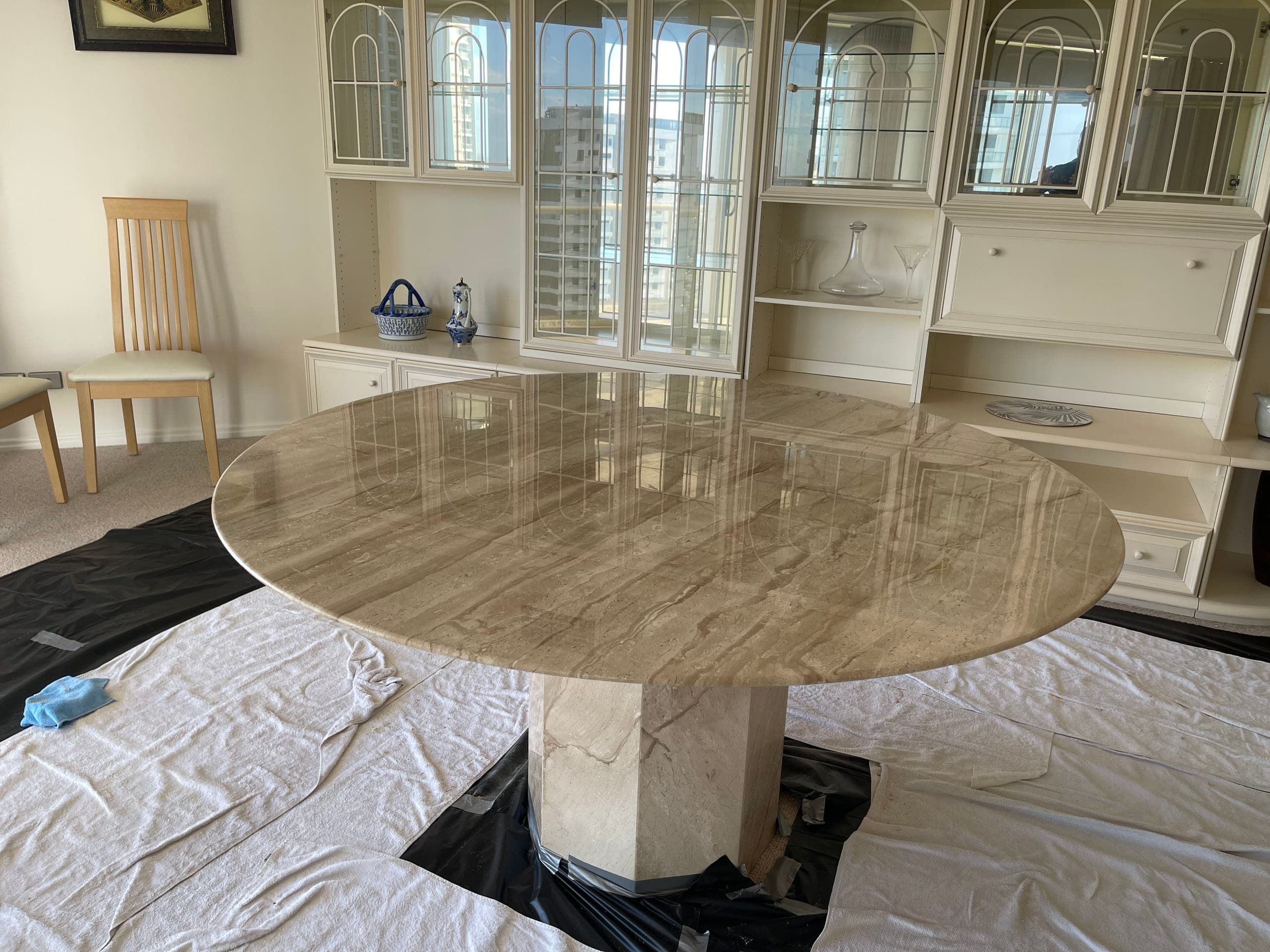
A round natural stone dining-table top that had broken clean through was reassembled, structurally bonded along the break, then machine-honed and polished until the repair line all but disappeared.
Why us
A restoration practice defined by method and material knowledge rather than marketing claims.
Questions
Yes. Marble floor restoration is core work here, from single rooms to whole-home floors. The floor is refined mechanically through progressively finer diamond stages so the finish is produced in the stone itself, then protected appropriately — no topical coating is laid over the top.
Yes. Whole-floor and whole-home restoration is preferable to spot-repair on most floors, because a patch rarely blends into the surrounding surface. The floor is brought to one consistent finish across the whole area rather than leaving a visible repaired section.
Yes. Apartment and high-rise work is a large share of what we do here. It comes with real constraints — booked lifts, restricted work hours, dust and noise limits and body corporate approval — which we plan around as part of scheduling the job.
No. Polishing refines a sound, flat surface; it does not fix lippage, deep scratching, etching or cracks. Where a floor has that kind of damage, the appropriate restoration stages — which may include grinding, honing and repairs — are carried out first, and mechanical polishing is the final stage only where the stone suits it.
Marble, limestone, travertine, terrazzo, granite, sandstone and bluestone, among other natural stone. Engineered and reconstituted stone behaves differently and is not restored the same way, because its surface is largely resin rather than stone.
Yes. A lot of Gold Coast terrazzo from the 1970s and 1980s survives under carpet, vinyl or tile and is often in better condition than expected. Restoring it is usually both cheaper and better-looking than covering it again, once its thickness and condition have been assessed.
Yes. Substantial residential restoration — whole-home natural stone floors, large floor areas, high-end residences and complex multi-area work — is core work, and we coordinate with homeowners, builders, architects and designers where a project calls for it.
Yes, for suitable commercial projects — foyers, common areas, body corporate environments, hospitality and retail. Commercial work is planned around the trading environment, including access, work hours and coordination with building management.
Clear photographs or video of the stone and the problem areas, the approximate area or measurements, the stone type if you know it, the property or location, and a short description of the condition. That is usually enough for an initial view on what the surface needs.
Send photographs, the approximate area or measurements, the stone type if known, the property or location, and a short description of the condition. You will get a straight answer about what the surface needs.