Black Marble Inlay – Bathroom
Brisbane
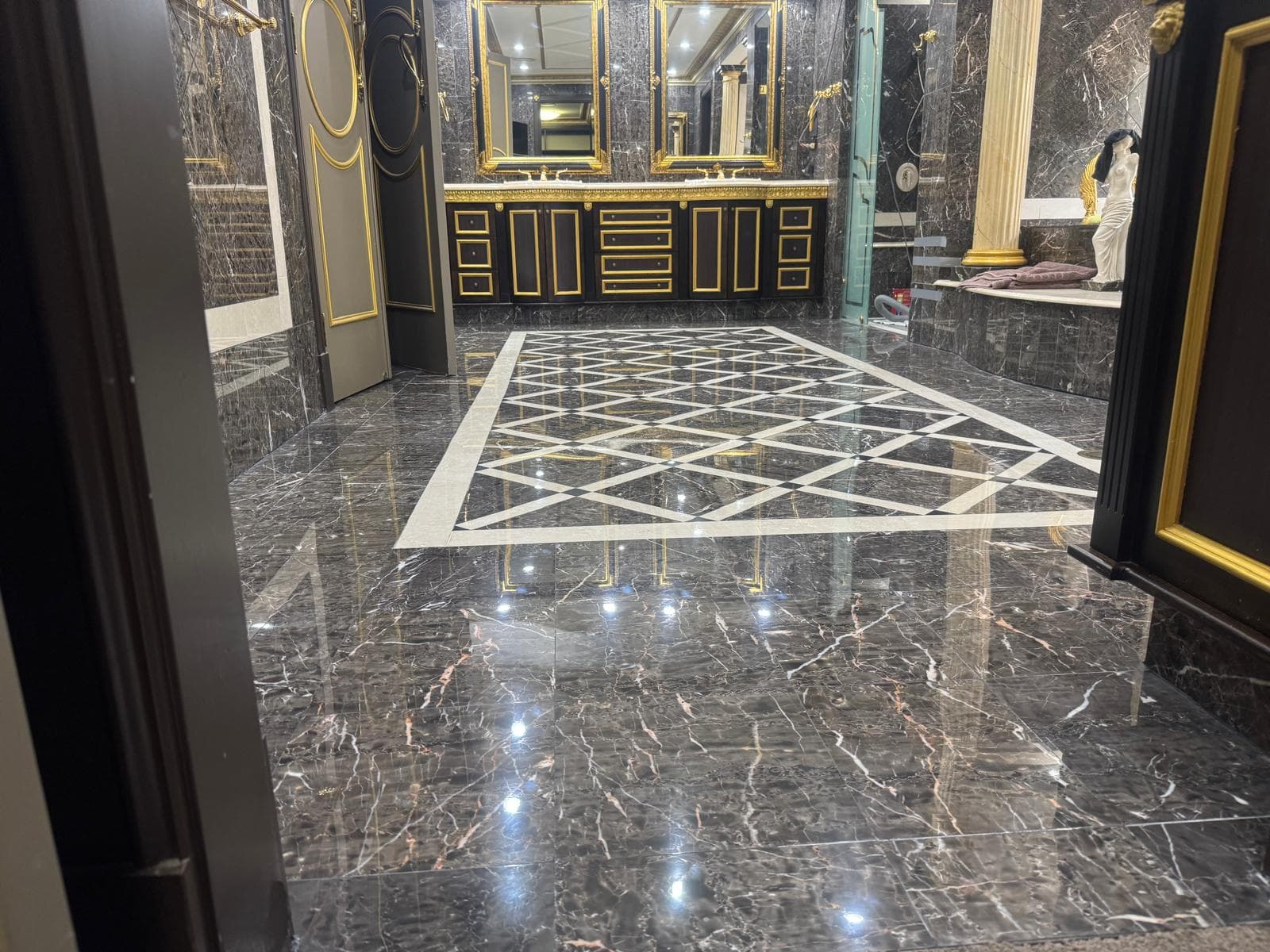
Precision restoration of a custom geometric marble inlay, levelled across every section to read as one continuous surface.
MarbleFloor Restoration
Professional Marble & Natural Stone Restoration — Gold Coast & Brisbane
Surfaces
Correction & Repair
Natural stone we restore
Compounds & treatments
Restoration
Wet-area stone, vanities and shower recesses. Where stone damage and failed joints usually arrive together.
The problem
Bathrooms combine constant moisture, soap products and confined ventilation, and stone shows it. The surface goes cloudy from mineral deposit and soap film. Grout darkens and breaks down. Silicone at the wall-to-floor junction discolours and lifts.
The stone and the joints usually fail together, which is why treating one alone tends to disappoint. A beautifully re-polished shower floor with failed grout around it still reads as a tired bathroom.
What gets established before any work starts
These decide the method. Answering them wrong wastes an entire stage.
Approach
Described as a set of judgements rather than a fixed sequence, because that is how it genuinely works.
Wet areas are treated as stone and joints together, sequenced so each stage does not undo the last. Joint work generally precedes final stone finishing, so that debris and residue are not driven into a freshly polished surface.
Deposit is removed before any judgement is made about the stone underneath. It is common for a surface to need far less work than it first appeared to.
Shower floors and small mosaics are worked by hand. The pieces are small, the falls are deliberate, and machine work is neither possible nor appropriate.
Protection is chosen for a permanently wet environment, which is a different decision from a dry floor.
Not every stage applies to every job. Which are used is decided at assessment.
Practicalities
The details that affect how the job runs, and that are easier to plan for than to discover midway.
Limits
Stated plainly, because finding out on the day suits nobody.
Materials
Each material behaves differently. The reference pages cover how, and how to look after them.
Evidence
Documented jobs, with the stone, location and condition recorded.
Questions
Usually not. Most of that appearance is mineral scale and soap film bonded to the surface, plus grout that has broken down. Once the deposit is off, the stone underneath is often in much better condition than expected.
In a wet area it usually makes sense. The joints are a large part of what you see, they are the most common failure point, and doing them separately means going over the same surfaces twice.
Related
Full-depth joint removal and rebuilding, including epoxy systems. A distinct intervention, not a stage of polishing.
Kitchen islands, bar tops and vanities re-finished in place. Etching, dulling and chipped edges corrected on the stone itself.
Drawing organic, oil, rust and mineral staining out of the stone rather than sealing it in.
Send photographs and a short description and you will get a straight answer about what the surface needs — including if the answer is that it does not need us.