Restoration
Grout & Epoxy Joint Restoration
Full-depth joint removal and rebuilding, including epoxy systems. A distinct intervention, not a stage of polishing.
The problem
What actually goes wrong
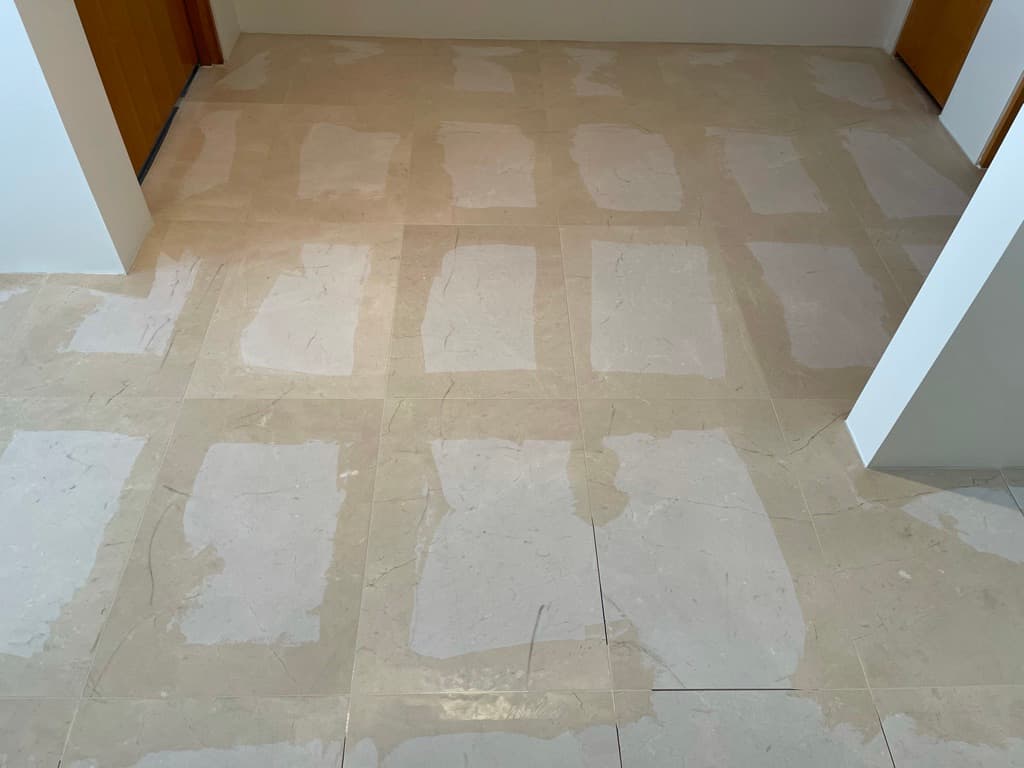
Grout fails from within. Cement-based grout is porous, and in a wet or heavily used area it absorbs, holds moisture and gradually breaks down. What shows on the surface as dark lines is often deterioration through the depth of the joint.
Surface regrouting — smearing new grout over the old — is a common response and a short-lived one. It leaves the failed material in place, so the new layer is bonded to something that is already breaking down, and it usually reappears within months.
There is also a purely visual failure: joints that are sound but inconsistent in colour, patchy from previous repairs, or simply the wrong shade for the stone.
Assessment
What gets established before any work starts
These decide the method. Answering them wrong wastes an entire stage.
- Establishing how deep the deterioration goes. This is the difference between a cosmetic job and a full-depth rebuild, and it determines the entire scope.
- Identifying the existing joint material. Cement-based grout and epoxy behave completely differently on removal.
- Checking joint width and depth, which governs what material can be used to rebuild.
- Looking for movement. A joint that keeps cracking in the same place is usually telling you something about the substrate rather than the grout.
Approach
How the work is decided
Described as a set of judgements rather than a fixed sequence, because that is how it genuinely works.
Where deterioration is at depth, the old material is raked out rather than covered. This is the part that makes the difference and the part that takes the time — mechanically removing failed grout from between fixed tiles without damaging their edges.
Joints are then rebuilt with a material chosen for that location. Epoxy systems are appropriate in some settings for their density and resistance to absorption; in others a cement-based product is the better choice, and the decision depends on the joint, the exposure and the stone.
Where the surrounding stone is also being restored, joint work is sequenced ahead of final finishing so that residue is not polished into the stone.
Colour is selected against the actual stone in the actual light, not from a chart.
Stages that may be involved
Not every stage applies to every job. Which are used is decided at assessment.
Practicalities
Things worth knowing in advance
The details that affect how the job runs, and that are easier to plan for than to discover midway.
- Epoxy is a decision, not a default
- Epoxy grout is dense and highly resistant to absorption, which makes it attractive in wet areas. It is also less forgiving to install and harder to remove later. Whether it is right depends on the joint width, the substrate and the exposure — treating it as automatically superior is a mistake.
- Removal is the risk, not the rebuild
- Raking out a joint between installed tiles is where damage happens if it is done carelessly. Tile edges — particularly on soft stone or a fine-glazed edge — can chip. This is skilled mechanical work and the main reason full-depth joint restoration costs more than a surface smear.
- Silicone is not grout
- Movement joints, internal corners and wall-to-floor junctions are meant to be flexible. Filling them with grout causes cracking, because the joint is there to accommodate movement. Those junctions are re-done in a flexible sealant.
Limits
What restoration will not fix
Stated plainly, because finding out on the day suits nobody.
- Recurring cracking in the same joint usually indicates substrate movement. Rebuilding the joint treats the symptom, and it will return unless the movement is addressed.
- Where tiles are drummy or lifting, the joint is not the problem and joint work will not fix it.
- Existing epoxy is significantly harder to remove than cement-based grout, which affects the scope of any rebuild.
Materials
Stone this applies to
Each material behaves differently. The reference pages cover how, and how to look after them.
Questions
Common questions
What is usually sold as regrouting applies new grout over the existing joint. This removes the failed material to depth first and rebuilds the joint. It is more work, and it is the reason the result lasts rather than reappearing in a few months.
Yes, where the joints are being rebuilt. Colour is chosen against the stone on site, because grout that looks right on a sample board frequently does not against the actual material in the actual light.
Where it suits the joint and the exposure. It is dense and resists absorption well, which is valuable in wet areas, but it is not automatically the right answer — joint width, substrate and the stone all bear on the choice.
Related
Often needed alongside this
Bathrooms & Showers
Wet-area stone, vanities and shower recesses. Where stone damage and failed joints usually arrive together.
Floor Restoration
Stone floors levelled, refined and finished on site. The finish is the stone itself, not a coating laid over it.
Repairs & Surface Correction
Chips, cracks, holes and lippage. Structural and cosmetic correction of damaged stone rather than replacement.
Have the stone assessed properly
Send photographs and a short description and you will get a straight answer about what the surface needs — including if the answer is that it does not need us.