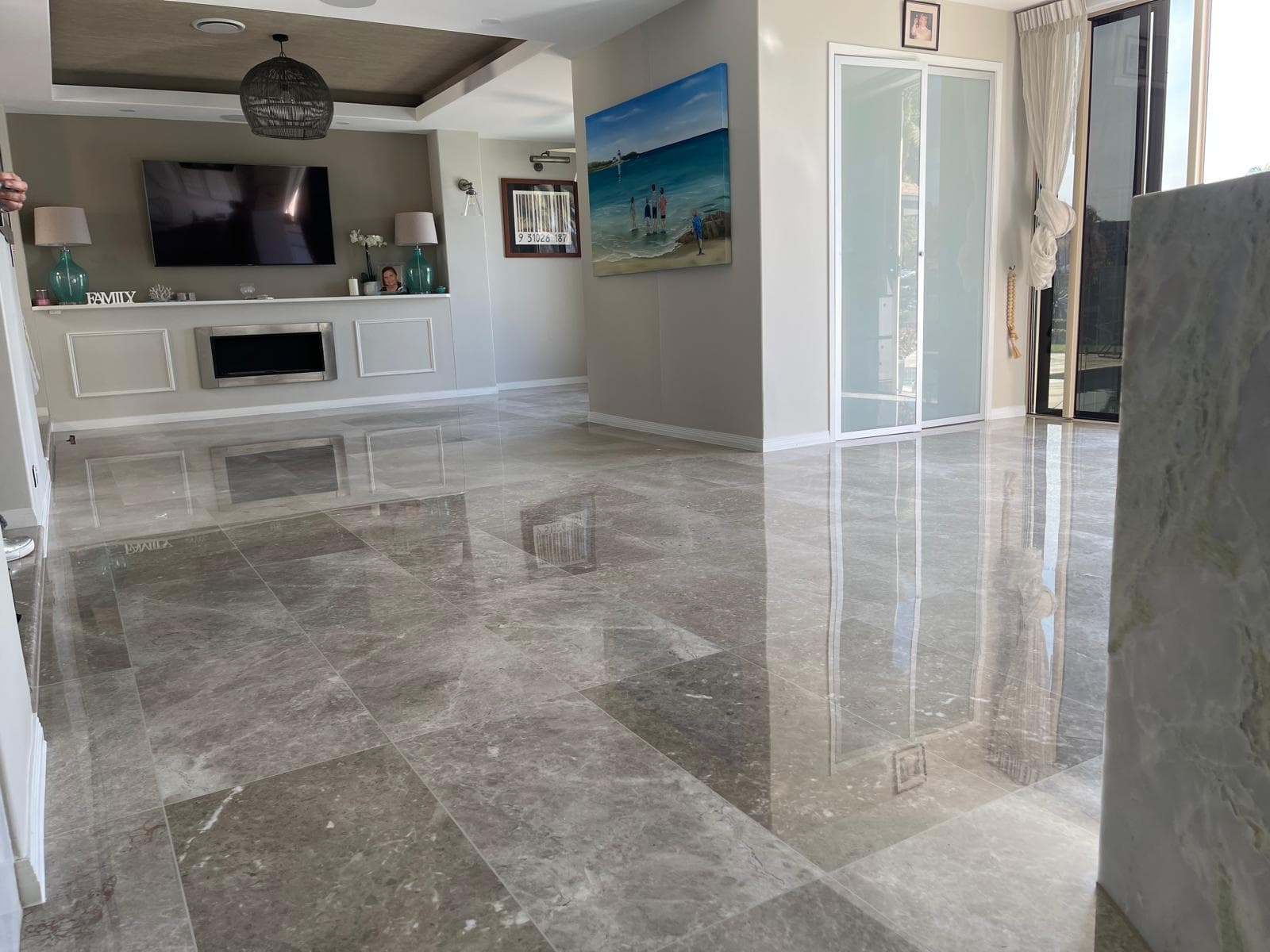
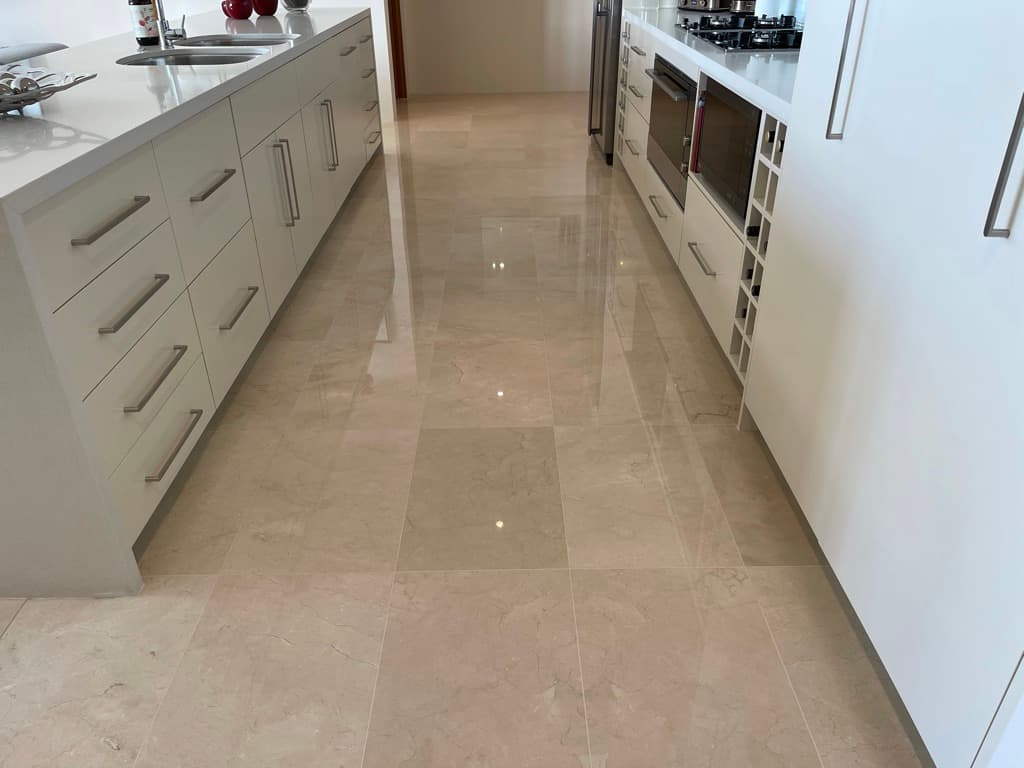
Old-School Craftsmanship. Modern Diamond Technology.
Natural Stone & Marble Floor Polishing and Restoration
Professional restoration for marble, limestone, travertine, terrazzo and natural stone floors across the Gold Coast and Brisbane.
From diamond refinishing and honing to surface correction, grinding and complete mechanical restoration, each floor is assessed individually and treated according to what the stone actually requires.
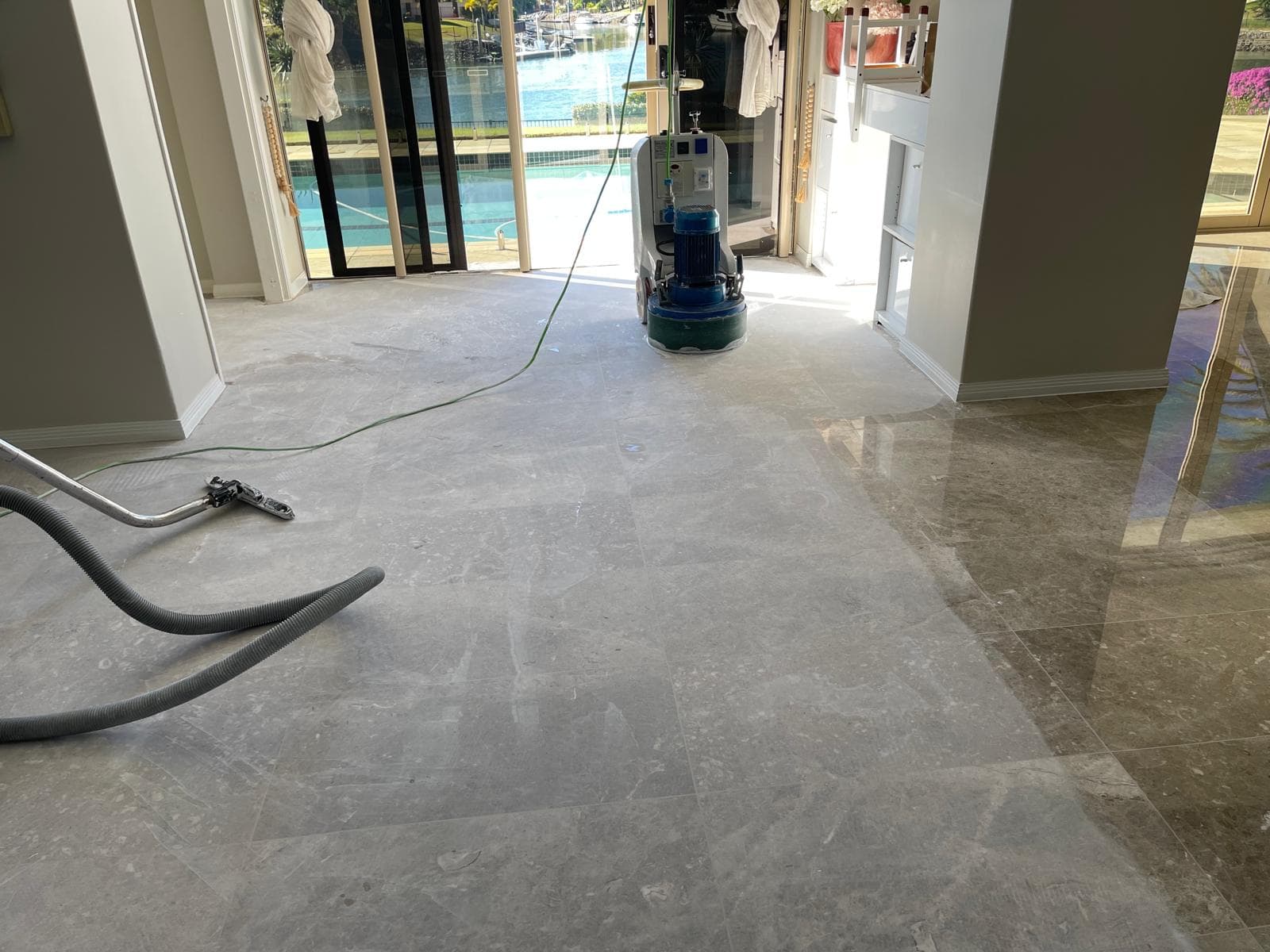
A marble or natural stone floor that has gone dull, worn, lightly scratched or etched does not automatically need to be ground back. Depending on its condition, professional diamond refinishing, re-polishing or honing is often enough to restore the existing surface and bring the finish back.
Where greater correction is required — deeper scratches, significant acid etching, uneven tiles, lippage or surface damage — the work can progress through more aggressive diamond stages to grinding, resurfacing, levelling and complete mechanical restoration. Which of those a floor needs is decided after it is assessed, not before.
From a simple refresh to a complete transformation, we treat the stone according to what it actually needs.
Diamond refinishing & re-polishing
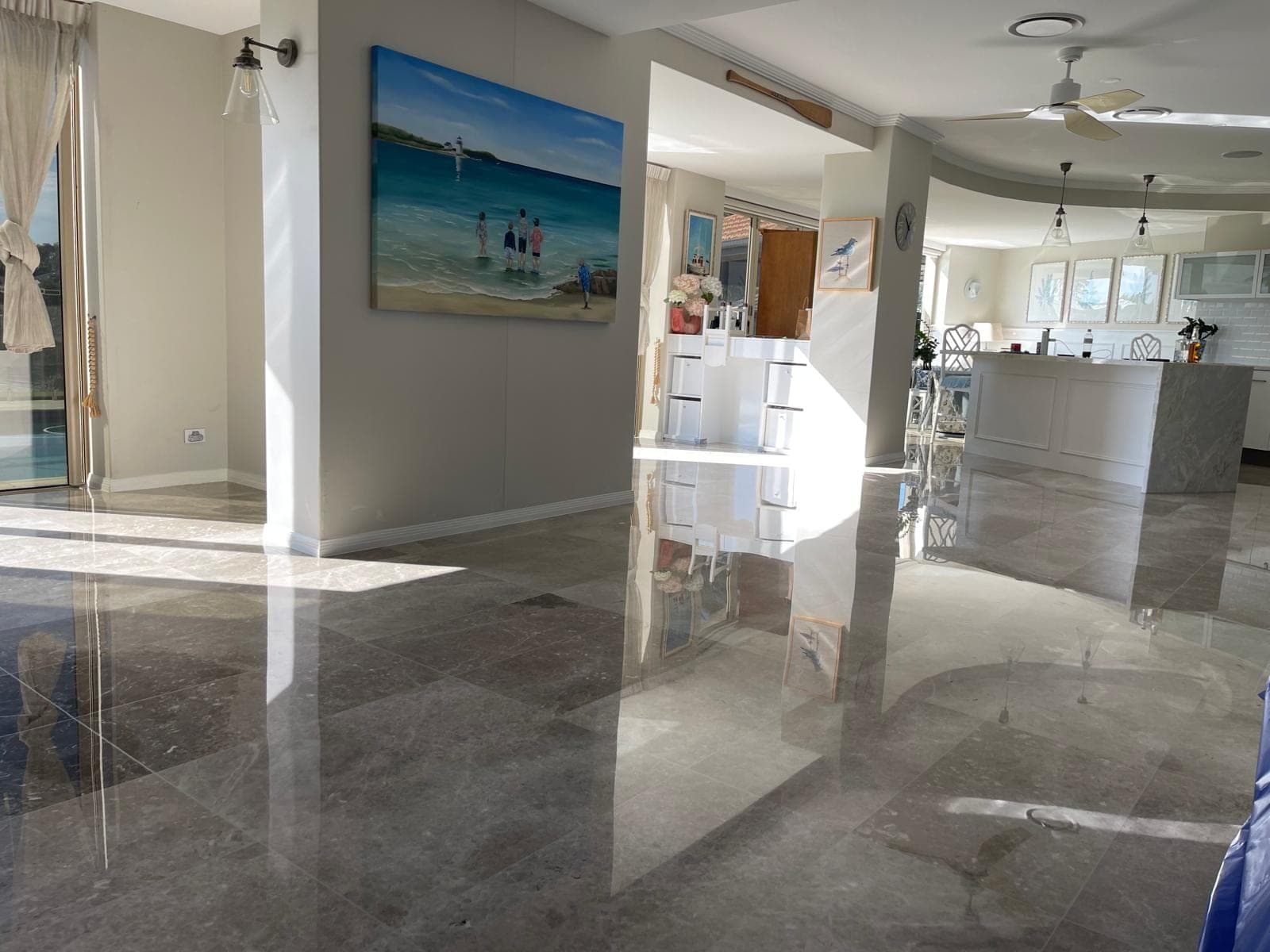
Floors showing dullness, traffic wear, loss of shine and light surface scratching or etching usually need progressive diamond refinishing rather than full grinding. The stone's own surface is refined and re-polished in place, restoring clarity and reflection without removing more material than the floor requires.
Where a finish is more worn, or etch marks and scratches are more pronounced, honing and the appropriate diamond stages correct the surface before it is refined to the finish you want — honed or polished. This is also where a damaged honed floor is made even and consistent again.
Floors with deeper damage — significant lippage, uneven tiles, deep scratches or failed joints — may need diamond grinding and levelling to flatten the surface before progressive mechanical restoration brings it back to a single, consistent finish. Deeper grinding is only used when the floor genuinely needs it.
You do not need to decide between polishing, honing, refinishing, grinding or full restoration before getting in touch. Send photographs of the floor and we will assess it and recommend the right level of treatment.
Not All Stone Refinishing Follows the Same Process
Natural stone can be treated in different ways depending on its condition and the result required. The machinery, diamond sequence and level of mechanical correction all influence the finished surface.
Stone Polishing Solutions combines decades of hands-on stone knowledge with modern planetary machinery and precision diamond technology to select the appropriate process for each individual floor.
Sometimes a floor requires only careful diamond refinishing or honing. Other surfaces require grinding, levelling and complete mechanical restoration. The objective is not to use the most aggressive process — it is to use the right one.
The right treatment for your stone — nothing more, nothing less.
The finish comes from the stone
Our mechanical refinishing process progressively develops the natural stone surface itself to achieve the appropriate honed, satin or polished finish.
Preserving your stone — removing only what is necessary
The starting diamond, machinery and restoration sequence are selected according to the material, installation, surface condition and required finish. The objective is to correct the surface while preserving as much of the original stone as practical.
The problem
What actually goes wrong
A stone floor loses its finish in two quite different ways, and they need different work. The surface can dull — foot traffic, cleaning chemicals and fine grit abrade the polish until the stone looks flat and grey. Or the floor can be physically uneven, where tiles sit at different heights and the edges catch underfoot.
Coatings are often applied to hide the first problem. A topical sealer or polymer gloss will look convincing for a while, then wear through in the traffic lanes and leave a patchy finish that cannot be spot-repaired. Removing a failed coating is usually more work than restoring the stone would have been.
Assessment
What gets established before any work starts
These decide the method. Answering them wrong wastes an entire stage.
Identifying the stone. Marble, limestone, travertine, terrazzo and granite all respond differently, and the wrong assumption wastes an entire abrasive stage.
Establishing whether the surface carries a coating. This changes the work fundamentally, because a coating must come off before the stone underneath can be read at all.
Checking flatness across the floor and at the joints, which determines whether levelling is needed or whether refinement alone will do.
Confirming the finish you actually want. A honed floor and a polished floor are different endpoints, and the choice affects every stage before it.
Approach
How the work is decided
Described as a set of judgements rather than a fixed sequence, because that is how it genuinely works.
The floor is assessed first, then a method is chosen for that floor. Some need levelling with metal-bond diamonds before anything else; others are structurally fine and need only progressive refinement to bring the surface back.
Where levelling is required, the work moves through successively finer diamond abrasives. Each stage removes the scratch pattern left by the one before it, which is why stages cannot be skipped once started — an unrefined scratch pattern stays visible under a polish.
Edges and perimeters are worked separately. A large machine cannot reach the last few centimetres against a wall or into a corner, and a floor that is perfect in the middle and dull at the edges reads as unfinished.
Protection is considered at the end rather than assumed. An impregnating sealer makes sense on porous stone; on dense granite it often achieves very little.
The treatment may range from diamond refinishing and re-polishing through to honing, corrective grinding and complete mechanical restoration. Not every stage applies to every floor.
Not every stage applies to every job. Which are used is decided at assessment.
Practicalities
Things worth knowing in advance
The details that affect how the job runs, and that are easier to plan for than to discover midway.
Stone Floor Levelling & Lippage Removal
Where tiles sit at different heights, levelling removes material from the high edges. How much can be taken off depends on tile thickness and how it was laid. On a thin tile over an uneven bed there is a real limit, and it is better to establish that before work starts than to discover it halfway.
Dust and site protection
Grinding stone generates a great deal of fine dust. Work is done wet or with extraction, and adjoining areas are sealed off. This matters most in occupied homes and trading commercial spaces.
Moisture and curing
Wet work introduces water into the floor. Stone needs to dry before sealing, and sealing a damp floor traps moisture. Timing is part of the method, not an afterthought.
Limits
What restoration will not fix
Stated plainly, because finding out on the day suits nobody.
Severe structural cracking usually needs to be addressed before surface restoration, and sometimes indicates movement that restoration alone will not fix.
Stone that has already been ground thin by repeated restoration has a finite amount of material left.
Deep staining that has penetrated the full thickness of the stone may lighten rather than disappear.
Materials
Stone this applies to
Each material behaves differently. The reference pages cover how, and how to look after them.
Yes. The work is done in place. Grinding, refinement and polishing all happen on the installed floor, which is why restoration is normally far less disruptive and less expensive than replacement.
It depends on the finish. Refinishing a single area to match the surrounding floor is possible but the match is rarely invisible, because the rest of the floor has worn. Where appearance across a continuous space matters, doing the whole area gives a consistent result.
That depends on the size of the area, the stages required and whether a sealer is applied. It is established during assessment rather than quoted generically, because a small bathroom and a whole ground floor are not comparable.
Tell us about your floor and upload a few photographs. We can review the stone, its condition and the scale of the project before discussing the most appropriate next step.