

Material guide
Terrazzo restoration and care
Stone or glass chips set in a cement or resin matrix. Two materials in one surface, each behaving differently.
Terrazzo is a composite: aggregate chips — usually marble, sometimes granite or glass — bound in a matrix of either cement or epoxy resin. Restoring it means working two materials at once, and the matrix is almost always the softer of the two.
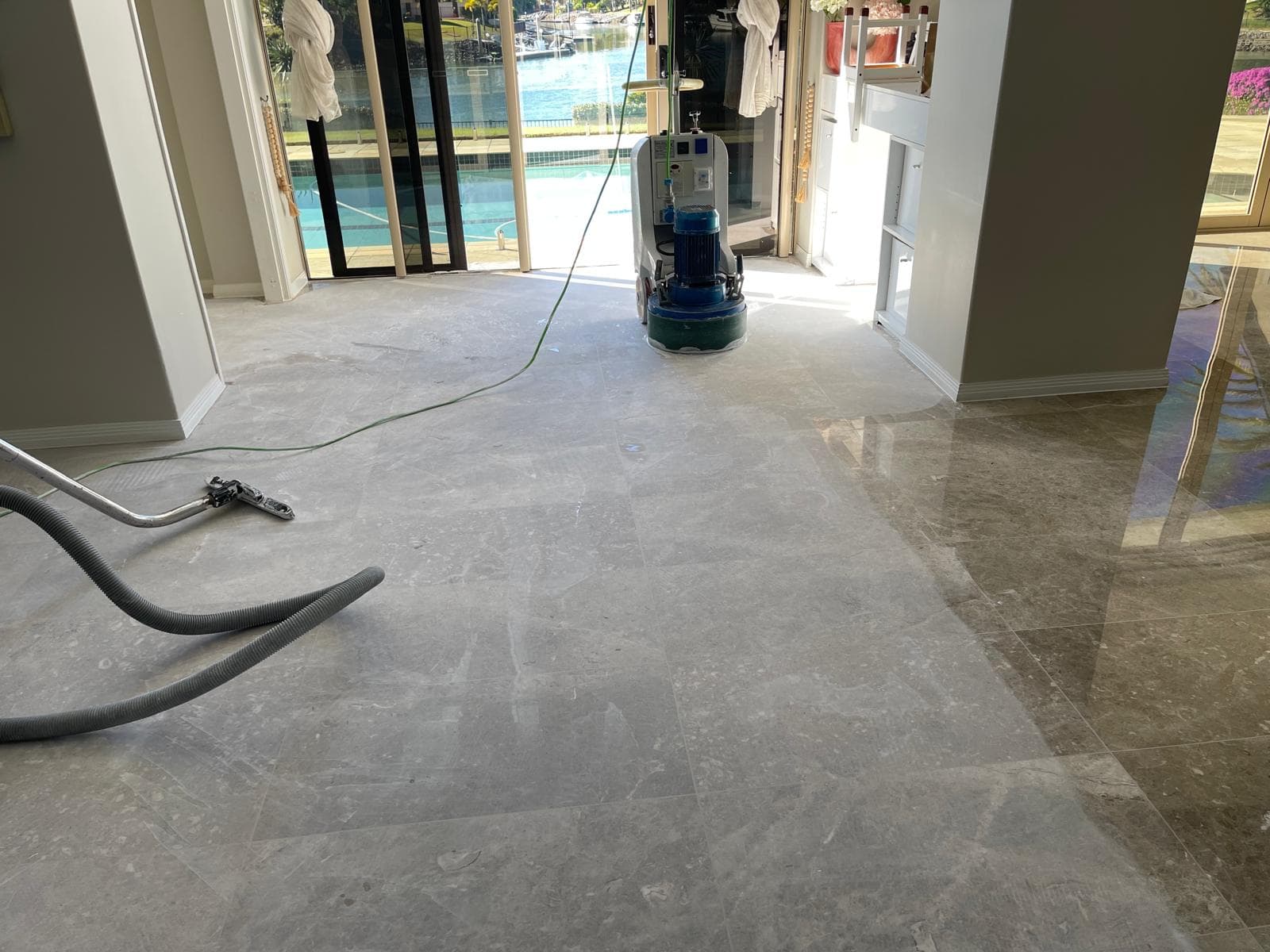
That difference is why worn terrazzo often feels slightly raised underfoot: the matrix has abraded faster than the chips, leaving the aggregate standing marginally proud. Grinding brings both back to a single plane, which is also what restores the crisp, terrazzo-specific look.
Cement-matrix terrazzo is alkaline and reacts to acid. Epoxy-matrix terrazzo is chemically tougher but can yellow with UV exposure and is less tolerant of heat. Identifying which one is present matters before anything else happens.
Behaviour
What makes terrazzo different
These properties are the reason the method changes. They are not trivia.
- Two-material surface: aggregate chips plus a binding matrix
- Cement matrix is acid-sensitive; epoxy matrix is more chemically resistant
- Matrix typically wears faster than the aggregate
- Grinds and polishes to a genuine mechanical finish
- Very durable — much terrazzo in service is decades old and fully recoverable
Common problems
What goes wrong, and whether it can be put right
Described as you would notice it, then what is physically happening, then what restoration can realistically achieve.
- 01
Dull, uneven surface with chips standing slightly proud
- Cause
- Differential wear — the matrix has abraded faster than the aggregate.
- Outlook
- Correctable. Grinding levels both materials to one plane, then the surface is refined and polished.
- 02
Yellowed, patchy coating that scuffs and peels
- Cause
- Decades of applied waxes and sealers. Terrazzo in older commercial and institutional buildings is frequently buried under layers of them.
- Outlook
- Correctable, and often dramatic — stripping the build-up commonly reveals aggregate the owner did not know was there.
- 03
Cracks following straight lines across the floor
- Cause
- Movement in the slab beneath, often at original control joints or where divider strips have failed.
- Outlook
- This is a substrate question, not a surface one. It can be filled and made good cosmetically, but if the slab is still moving it will return. Worth an honest look before committing.
Looking after it
Day-to-day care for terrazzo
A good share of the damage we repair was avoidable. This is the short version of how to avoid it.
Do
- Dust-mop regularly to keep grit off the surface
- Clean with pH-neutral products
- Address coating build-up rather than adding more layers
Avoid
- Acidic cleaners on cement-matrix terrazzo
- Repeated wax applications as a substitute for refinishing
- Abrasive scrubbing pads on polished terrazzo
Finishes
Finishes achievable on this stone
The finish is chosen to suit the stone and the room it is in, not applied as a default.
- polished
- honed
- matte
Other materials
We restore more than one kind of stone
Looking for a particular job rather than a particular stone? Browse stone restoration by what needs doing.
Not sure what your terrazzo needs?
Whether the matrix is cement or epoxy changes what can safely be used on the floor, and it is not always obvious by eye. Identifying it is part of the assessment.

