Restoration
Commercial Stone Restoration
Lobbies, hotels, retail and body-corporate stone. Restored in stages around trading hours and occupied buildings.
The problem
What actually goes wrong
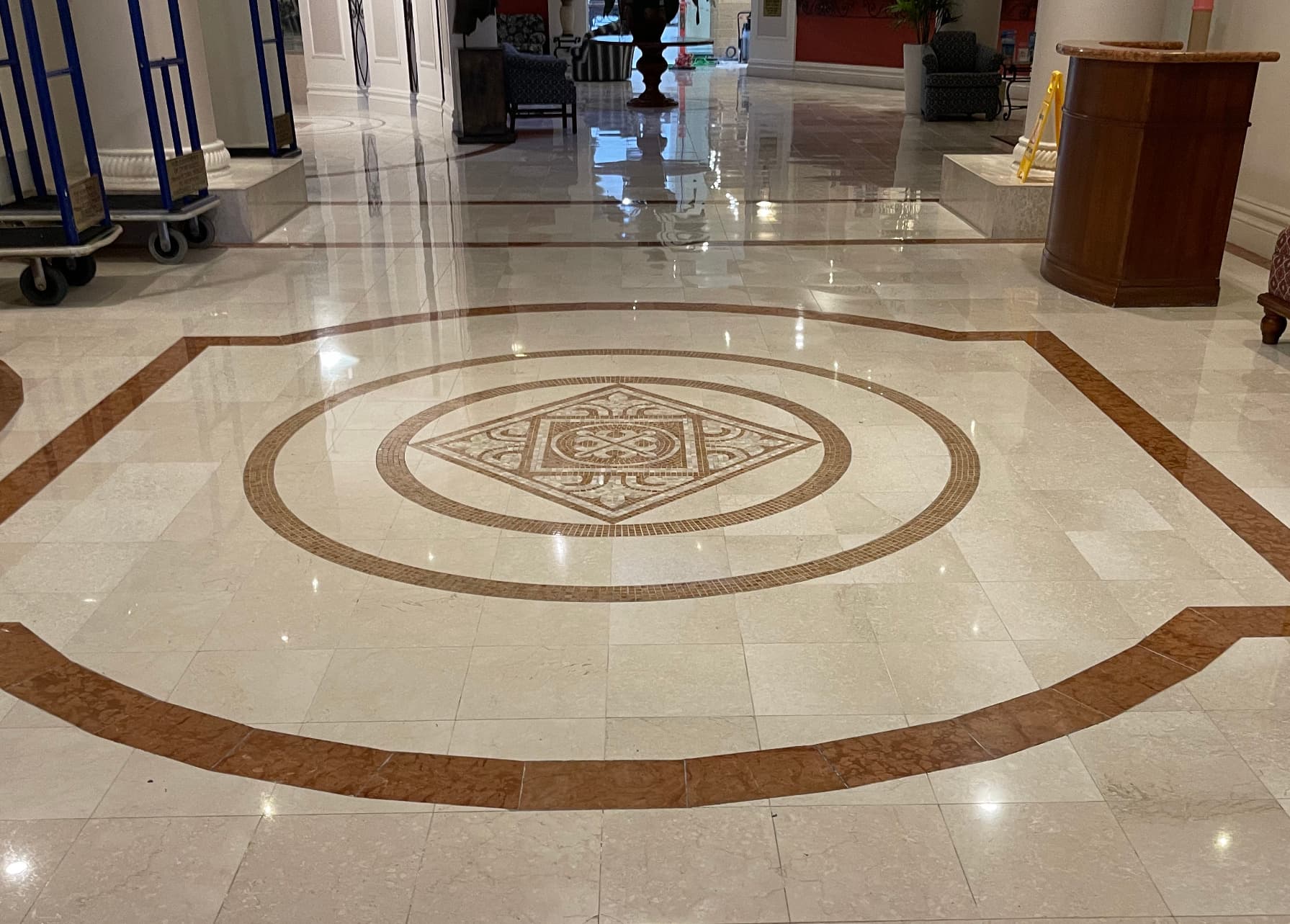
Commercial stone fails faster because of volume. A hotel lobby or retail entrance takes in a day what a home takes in months, and it takes it along fixed paths, so wear appears as defined traffic lanes rather than general dulling.
The constraint is rarely the stone. It is access. The building keeps trading, the space cannot be closed, and the work has to fit around occupancy, deliveries and other trades.
Assessment
What gets established before any work starts
These decide the method. Answering them wrong wastes an entire stage.
- Establishing the real access window — overnight, staged by zone, or a full closure — because it shapes the entire method.
- Mapping wear by zone. Entry and lift lobbies usually need markedly more than the areas around them.
- Identifying previous maintenance, which in commercial buildings frequently means accumulated coatings.
- Understanding the finish the building needs, which is often a serviceable, maintainable honed surface rather than the highest possible gloss.
Approach
How the work is decided
Described as a set of judgements rather than a fixed sequence, because that is how it genuinely works.
Work is planned in zones so the building keeps functioning. Each zone is taken to a finished state before the next begins, rather than leaving several areas part-done.
Dust and noise containment is planned as part of the method, not managed as it arises. In an occupied building this is often the difference between a job that can proceed and one that cannot.
Where the aim is long-term serviceability, a maintainable finish is specified over a maximum one. A surface that can be kept up with routine cleaning is worth more to a building than a gloss that degrades in three months.
Ongoing maintenance can be planned so the stone is kept rather than allowed to decline to the point of needing full restoration again.
Stages that may be involved
Not every stage applies to every job. Which are used is decided at assessment.
Practicalities
Things worth knowing in advance
The details that affect how the job runs, and that are easier to plan for than to discover midway.
- Access dictates the programme
- Overnight work, staged zones and restricted lift access all change how long a job takes and how it is sequenced. This is established before quoting, because it affects the scope more than the floor area does.
- Site requirements
- Commercial sites carry induction, insurance and documentation requirements that vary by building. These are handled as part of planning.
Limits
What restoration will not fix
Stated plainly, because finding out on the day suits nobody.
- Some finishes are not appropriate for high-traffic commercial floors, because they will not survive the volume.
- Zoned work in a trading building takes longer in elapsed time than the same area with full access.
Materials
Stone this applies to
Each material behaves differently. The reference pages cover how, and how to look after them.
Questions
Common questions
Frequently, yes, and in retail and hospitality it is often the only workable approach. It needs establishing early because it affects sequencing and programme rather than just start times.
That is usually the better commercial outcome. Once a floor has been brought to a defined standard, a planned maintenance interval keeps it there and avoids the cost of a full restoration every few years.
Related
Often needed alongside this
Floor Restoration
Stone floors levelled, refined and finished on site. The finish is the stone itself, not a coating laid over it.
Large Residential
Whole-home and multi-level stone across floors, bathrooms, kitchens and external areas, sequenced as one programme.
Coating & Sealer Removal
Stripping failed topical coatings, polymer gloss and old sealers back to raw stone so the surface can be read and restored.
Have the stone assessed properly
Send photographs and a short description and you will get a straight answer about what the surface needs — including if the answer is that it does not need us.